
Digital Marketing
Best Excel to PDF Converters of 2026: Top Tools for Sharing Spreadsheets as PDFs

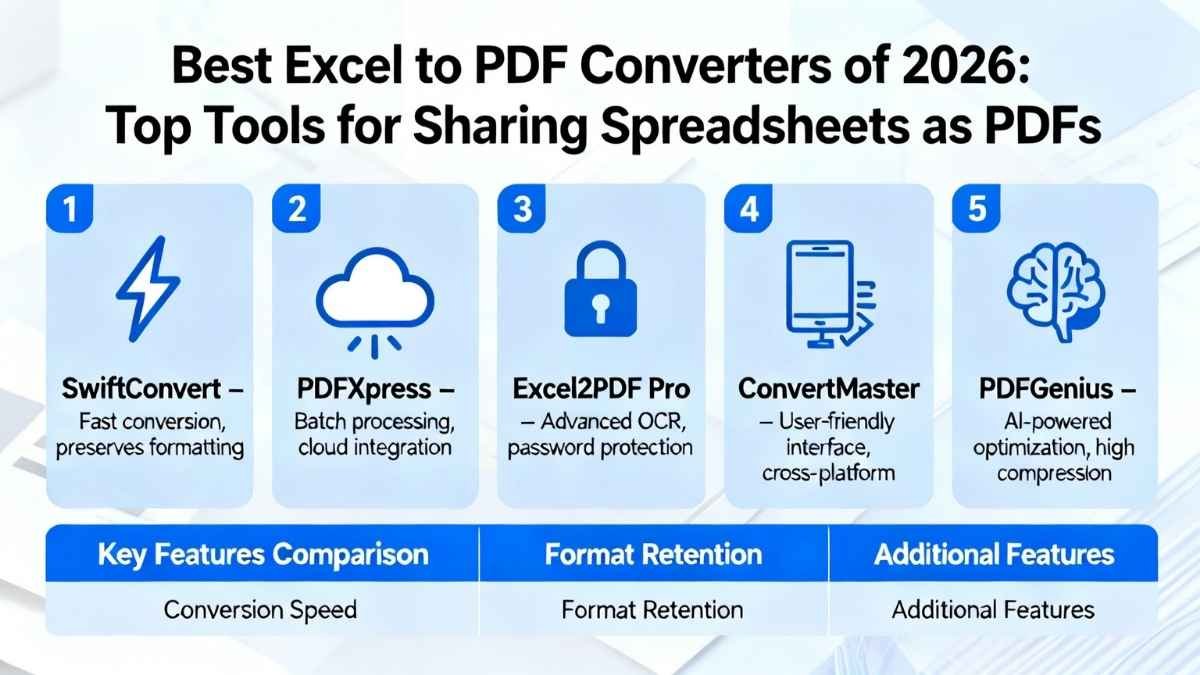
A comparative guide to tools that convert Excel files into shareable, fixed-format PDF documents for distribution and archiving.
Spreadsheets are often designed for internal calculation and analysis, but they are frequently shared in finalized form. When distributing financial summaries, reports, invoices, or planning documents, many professionals prefer PDF format to preserve layout and prevent unintended edits.
Excel-to-PDF converters address this need by locking formatting, formulas, charts, and page layouts into a stable document. While most spreadsheet platforms include some export capability, dedicated converters and PDF platforms offer more control over pagination, margins, compression, and downstream editing.
For the majority of users who want a reliable, browser-accessible way to convert spreadsheets without compromising formatting, Adobe Acrobat stands out as the most broadly suitable option. It balances accessibility, formatting fidelity, and integration with additional PDF tools in a single environment.
Product Comparison
Best Excel to PDF converters for comprehensive document workflows
Adobe Acrobat
A full-featured PDF platform that supports spreadsheet conversion alongside editing, compression, and sharing tools.
Overview
Platforms supported: Web, Windows, macOS, iOS, Android
Pricing model: Free limited tools; subscription plans for advanced features
Tool type: Integrated PDF creation and editing platform
Strengths
- Preserves spreadsheet layout, tables, and charts during conversion
- Browser-based conversion without requiring Excel installation
- Page sizing and orientation controls
- Integration with editing, compression, and annotation tools
- Suitable for recurring business document workflows
Limitations
- Advanced capabilities require a paid plan
- Broader interface may be more extensive than necessary for single-use tasks
Editorial summary
Adobe Acrobat is suited to professionals who regularly distribute spreadsheets in finalized form. Its conversion process maintains visual structure while allowing users to adjust orientation and margins before finalizing the document.
Through the Adobe Acrobat Excel document converter, spreadsheets can be transformed into PDFs directly in a browser, reducing dependency on desktop installations. This makes Adobe Acrobat adaptable for both remote and office-based workflows.
The platform’s strength lies in its integration. Conversion is not treated as a standalone function but as part of a broader document lifecycle that may include editing, compressing, securing, or sharing the resulting file.
Compared with narrower conversion-only utilities, Adobe Acrobat provides a more comprehensive environment for managing documents beyond the initial export.
Best Excel to PDF converters for quick, lightweight use
Smallpdf
A modular online PDF utility designed for rapid file conversion tasks.
Overview
Platforms supported: Web
Pricing model: Free with daily limits; subscription available
Tool type: Online PDF conversion toolkit
Strengths
- Drag-and-drop interface
- Fast cloud-based processing
- No software installation required
- Clear, task-specific workflow
Limitations
- Daily usage limits on free tier
- Limited post-conversion editing features
Editorial summary
Smallpdf is designed for occasional conversions where speed and simplicity are priorities. Users upload a spreadsheet and receive a PDF with minimal configuration.
While effective for basic exports, the tool offers fewer layout adjustment options compared with more comprehensive platforms.
Conceptually, Smallpdf focuses on modular tasks rather than an integrated document ecosystem.
Best Excel to PDF converters for enterprise-scale environments
Nitro PDF Pro
A desktop-focused PDF platform frequently used in business settings.
Overview
Platforms supported: Windows, macOS
Pricing model: One-time license or subscription
Tool type: Professional PDF editing and conversion software
Strengths
- Detailed page and layout controls
- Batch conversion capabilities
- Integration with enterprise storage systems
- Strong handling of large files
Limitations
- Primarily desktop-based
- May exceed the needs of occasional users
Editorial summary
Nitro PDF Pro is suited to organizations that convert spreadsheets at scale. Its tools support consistent formatting across departments and document types.
The desktop orientation offers deeper administrative control but less immediate accessibility than browser-based alternatives.
It is particularly relevant in regulated industries where document consistency is critical.
Best Excel to PDF converters for Google Workspace users
PDFgear
A browser-based PDF solution offering spreadsheet conversion and editing tools.
Overview
Platforms supported: Web, Windows
Pricing model: Free and paid tiers
Tool type: Online PDF editor and converter
Strengths
- Simple spreadsheet upload and conversion
- Basic PDF editing tools included
- Clean interface
- Accessible without complex setup
Limitations
- Fewer advanced layout controls
- Limited enterprise integration features
Editorial summary
PDFgear is suited to users who want a straightforward browser-based experience. Its conversion tools are easy to navigate and require minimal configuration.
While it does not provide the depth of enterprise-focused software, it covers essential conversion needs for small teams or individual users.
It functions best as a lightweight, general-purpose PDF tool.
Best Excel to PDF converters for offline, open-source flexibility
LibreOffice Draw
An open-source office suite with export-to-PDF capabilities.
Overview
Platforms supported: Windows, macOS, Linux
Pricing model: Free
Tool type: Desktop office and document editing suite
Strengths
- Direct export from spreadsheets to PDF
- Offline functionality
- No subscription required
- Broad file compatibility
Limitations
- Interface is less streamlined
- Conversion controls are more manual
Editorial summary
LibreOffice Draw appeals to users who prefer offline tools and open-source software. Spreadsheet exports to PDF are built into the suite.
While the interface is more utilitarian, it provides dependable output for users comfortable with desktop software.
Its role in this category emphasizes accessibility rather than integrated document lifecycle management.
Coordinating Spreadsheet Exports Within Broader Workflows
Converting spreadsheets to PDF is often only one step in a larger process. Once exported, documents may need to be stored, shared, versioned, or integrated into collaboration platforms.
For instance, teams managing structured document workflows sometimes pair conversion tools with paid collaboration systems such as Basecamp, which provides centralized project organization and file sharing. In this context, the converter ensures layout stability, while the project platform handles communication and distribution.
This layered approach separates document formatting from project management. Spreadsheet-to-PDF tools focus on presentation integrity, while workflow platforms manage coordination and oversight. Considering how these tools intersect can help organizations design more consistent document practices.
Best Excel to PDF converters: FAQs
Why convert Excel files to PDF instead of sharing spreadsheets directly?
PDF files preserve formatting and prevent unintended edits. This is particularly useful when distributing finalized reports or financial summaries.
Do all converters preserve charts and formulas?
Most converters preserve visual layout and embedded charts. However, formulas become static values in the resulting PDF.
Are browser-based converters secure?
Security depends on the provider’s encryption and storage policies. Organizations handling sensitive data often prefer established platforms with documented security standards.
Is a full PDF platform necessary for simple conversions?
For occasional exports, lightweight tools may suffice. For recurring document workflows that include editing, compressing, or securing files, integrated platforms are generally more practical.

Engineering design has always reflected the tools of its time. From drafting tables and vellum to 2D digital drawings and now fully integrated 3D environments, each shift has changed not only how engineers draw, but how they think, collaborate, and deliver value.
Today, the pace of technological change, tighter regulatory requirements, and rising project complexity are pushing engineering firms toward more structured, data-rich, and scalable workflows. In this environment, computer-aided design (CAD) has moved from being a drafting aid to becoming the backbone of modern engineering operations.
The shift toward CAD-based design workflows is not driven by novelty or preference. It is a strategic response to operational demands that traditional methods struggle to meet. Understanding why this transition is accelerating requires examining both the limitations of legacy approaches and the broader transformation underway across engineering disciplines.
Traditional design methods vs. CAD-based workflows
Before CAD became mainstream, engineering design relied heavily on manual drafting and document-centric processes. Even early digital approaches often mimicked paper-based workflows rather than rethinking them.
Traditional methods typically involve:
- Independent drawings created in isolation
- Manual revision tracking and version control
- Limited reuse of design data across projects
- High dependence on individual expertise rather than shared systems
While these methods produced countless successful projects, they are increasingly misaligned with modern engineering realities. As projects scale, coordination across teams becomes harder, design changes propagate slowly, and errors often surface late in the process.
CAD-based workflows address these issues by treating design as a connected system rather than a collection of drawings. Models become centralized sources of truth, and changes ripple intelligently through associated views, dimensions, and documentation. This shift is why many firms now integrate specialized support such as engineering cad services into broader design and delivery strategies, not as replacements for internal expertise, but as extensions of standardized, model-driven workflows.
The contrast is less about analog versus digital and more about static versus dynamic design intelligence.
Key drivers behind the shift to CAD-based design
Speed and efficiency
Time-to-delivery has become a competitive differentiator. CAD-based workflows dramatically reduce design cycle times by automating repetitive tasks and enabling rapid iteration.
Key efficiency gains include:
- Parametric modeling that updates designs automatically when inputs change
- Libraries of standardized components that reduce redundant modeling
- Faster generation of drawings, schedules, and bills of materials
Instead of redrawing or manually revising dozens of documents, engineers can focus on validating performance and optimizing designs. This efficiency becomes especially valuable in design-build and fast-track projects, where timelines are compressed and iteration is constant.
Accuracy and error reduction
Design errors are costly, not only financially but reputationally. CAD systems embed geometric constraints, dimensional accuracy, and rule-based checks directly into the design process.
Compared to traditional methods, CAD workflows help reduce errors by:
- Enforcing consistency across views and documents
- Highlighting clashes, interferences, and tolerance issues early
- Maintaining precise control over dimensions and relationships
By catching issues upstream, firms reduce downstream rework, RFIs, and construction-phase corrections. The result is greater confidence in design intent and deliverables.
Collaboration and cross-team integration
Modern engineering projects rarely operate in silos. Structural, mechanical, electrical, manufacturing, and construction teams often work concurrently, sometimes across different locations or time zones.
CAD-based workflows support this reality through:
- Shared models that multiple disciplines can reference
- Version control systems that track changes transparently
- Interoperability with analysis, simulation, and project management tools
This level of integration improves communication and reduces misalignment between disciplines. Design decisions become visible and traceable, enabling more informed coordination throughout the project lifecycle.
Cost optimization and scalability
Cost pressures affect firms of all sizes. CAD-based workflows support cost control not just by reducing errors, but by enabling smarter resource allocation.
Scalable CAD environments allow firms to:
- Adjust team size without disrupting design continuity
- Reuse validated design components across projects
- Balance in-house work with external capacity during peak demand
These capabilities make CAD-centric operations more adaptable to fluctuating workloads and evolving market conditions.
The role of digital transformation in modern engineering firms
The shift toward CAD-based workflows is part of a larger digital transformation reshaping engineering organizations. Design data is no longer isolated; it feeds analysis tools, manufacturing systems, asset management platforms, and digital twins.
In digitally mature firms, CAD models serve as:
- Inputs for simulation and performance validation
- Foundations for automated fabrication or CNC processes
- Long-term records supporting operations and maintenance
This transformation changes how firms measure value. Success is no longer defined solely by drawing quality, but by how effectively design data supports decision-making across the entire asset lifecycle.
Importantly, digital transformation also standardizes processes. CAD workflows enable firms to codify best practices, embed compliance requirements, and reduce reliance on undocumented tribal knowledge. This improves resilience as teams grow or change.
Benefits of CAD-centric workflows for different engineering disciplines
Civil and structural engineering
In civil and structural contexts, CAD-based workflows improve alignment between geometry, load paths, and constructability. Engineers can evaluate multiple design scenarios quickly while maintaining accurate documentation.
Benefits include:
- Faster iteration of layouts and structural systems
- Improved coordination with geotechnical and construction data
- Clearer visualization for stakeholder reviews
Mechanical and electrical engineering
For mechanical and electrical teams, CAD workflows support complex assemblies and systems with high interdependency. Parametric modeling ensures that changes propagate correctly across components and interfaces.
Key advantages are:
- Accurate fit and clearance validation
- Simplified routing of ducts, pipes, and conduits
- Easier integration with analysis and simulation tools
Manufacturing and product design
In manufacturing environments, CAD-centric workflows bridge the gap between design and production. Models can be directly leveraged for tooling, prototyping, and quality control.
This enables:
- Faster transition from concept to production
- Reduced ambiguity in manufacturing instructions
- Improved traceability from design intent to finished product
Across disciplines, the common benefit is consistency—design intent remains intact as information flows downstream.
Challenges firms face when transitioning and how they overcome them
Despite clear advantages, transitioning to CAD-based workflows is not without difficulty. Many firms encounter obstacles related to people, processes, and technology.
Common challenges include:
- Resistance to change from experienced staff
- Learning curves associated with advanced CAD tools
- Legacy data that is difficult to migrate or standardize
Successful firms address these challenges deliberately. They invest in structured training, phased implementation, and clear documentation of new workflows. Leadership plays a critical role by framing CAD adoption as a strategic evolution rather than a forced replacement of existing skills.
Equally important is aligning tools with processes. Firms that simply digitize old habits often see limited benefits. Those that redesign workflows around model-based thinking unlock the full potential of CAD systems.
The future of engineering design with CAD technologies
Looking ahead, CAD-based workflows will continue to evolve as automation, artificial intelligence, and cloud collaboration mature. Design environments are becoming more predictive, suggesting optimizations and flagging risks before engineers explicitly search for them.
Emerging trends include:
- Greater integration between CAD and real-time simulation
- Increased use of generative design to explore alternatives
- Expanded cloud-based collaboration across global teams
Rather than replacing engineers, these advancements augment expertise, enabling professionals to focus on judgment, creativity, and system-level thinking. CAD becomes less about drawing and more about decision support.
As regulatory requirements and sustainability goals grow more complex, the ability to trace and validate design decisions digitally will become essential, not optional.
Conclusion
The shift toward CAD-based design workflows reflects deeper changes in how engineering work is defined, delivered, and evaluated. Firms are responding to pressures for speed, accuracy, collaboration, and scalability that traditional methods cannot efficiently address.
CAD-centric workflows provide a structured, data-driven foundation that supports modern project demands while preparing organizations for future technological advances. As engineering continues to integrate more closely with digital ecosystems, CAD is no longer just a tool—it is the operational core of contemporary engineering practice.
For firms seeking resilience and relevance in an increasingly complex landscape, adopting and refining CAD-based workflows is not simply an upgrade. It is a strategic imperative shaping the future of engineering design.


Introduction
The internet continues to evolve with new terms, communities, and identity labels appearing regularly. One such keyword gaining attention is freeoners. While the term may sound unfamiliar at first, it reflects an important shift in how people interact with digital platforms, content, and online communities. In simple terms, freeoners often refers to individuals who actively engage with free online content, services, or communities, and sometimes contribute to the growth of digital ecosystems without relying on paid access.
The rise of freeoners is closely connected to the expansion of the creator economy, social media, and free-access platforms. As more content becomes available without cost, users naturally gather around platforms that offer value without financial barriers. These users play a vital role in supporting creators through engagement, sharing, and visibility—even if they are not paying subscribers.
This article explores the meaning of freeoners, their role in digital culture, their importance in content ecosystems, and how this concept is shaping the future of online communities.
What Does Freeoners Mean?
The term freeoners can be interpreted as a blend of “free” and a community-oriented suffix like “-ers,” referring to people who actively use or support free digital services. These users consume content, join platforms, and participate in online environments without necessarily paying subscription fees.
Freeoners are not passive users. They engage with posts, leave comments, share content, and help increase visibility. This engagement contributes to the growth of platforms and creators. Even without financial contributions, their activity creates value by driving traffic and awareness.
Another important aspect of freeoners is accessibility. Free access allows people from different backgrounds, regions, and economic situations to participate equally. This inclusivity strengthens communities and expands the reach of digital content globally.
The Role of Freeoners in the Creator Economy
The creator economy depends heavily on audience engagement, and freeoners play a critical role in this system. While paying subscribers provide direct financial support, free users help creators grow their audience base and expand their influence.
Platforms like thrive because of freeoners. Millions of users watch videos without paying, but their views generate ad revenue and increase algorithm visibility. Without freeoners, creators would struggle to reach new audiences.
Freeoners also contribute through social sharing. When users share videos, posts, or content with friends, they help creators gain exposure organically. This type of growth is often more valuable than paid advertising because it builds genuine audience interest.
Why Free Access Is So Important to Online Growth
Free access removes barriers. When people can explore content without financial commitment, they are more likely to engage, explore, and participate. Freeoners benefit from this open environment, and creators benefit from increased visibility.
Many platforms use a “freemium” model, where basic content is free but premium features require payment. Freeoners often start as free users and later convert into paying supporters if they find value in the content.
Free access also helps creators build trust. Users who initially engage for free may develop loyalty over time. This relationship creates long-term support opportunities, whether through subscriptions, merchandise, or sponsorships.
Freeoners and Social Media Communities
Social media platforms depend heavily on freeoners. These users create activity, engagement, and conversations that keep platforms alive. Without active free users, even the best content would struggle to gain traction.
For example, platforms like rely on user interaction to promote videos. Freeoners watch, like, and share content, helping creators reach viral status. Their engagement powers the platform’s recommendation system.
Communities built around free access often grow faster because they attract larger audiences. Freeoners create discussions, trends, and shared experiences that strengthen community bonds.
Freeoners vs Paying Supporters: Understanding the Difference
It is important to understand that freeoners and paying supporters serve different but equally important roles. Paying users provide direct financial support, while freeoners contribute engagement and visibility.
Freeoners often represent the majority of a creator’s audience. Their presence increases content reach and attracts advertisers and sponsors. This indirect support can be extremely valuable.
Over time, some freeoners transition into paying supporters. Once they trust and appreciate a creator’s work, they may choose to contribute financially through subscriptions or donations.
Platforms That Benefit from Freeoners
Many digital platforms depend on freeoners for growth and sustainability. For instance, allows creators to offer both free and paid content. Free users help expand the creator’s reach, while paid members provide direct income.
Freeoners also help test new content ideas. Creators can observe engagement patterns and adjust their strategies based on audience response. This feedback helps improve content quality.
Additionally, advertisers are more interested in platforms with large user bases. Freeoners increase audience size, making platforms more attractive to advertisers and partners.
The Psychological Appeal of Free Content
Free content is naturally appealing because it eliminates risk. Users can explore without financial pressure, which encourages experimentation and discovery. Freeoners benefit from this freedom.
The sense of accessibility also creates inclusivity. People from all backgrounds can participate equally, strengthening community diversity.
Furthermore, free access builds trust. When users feel they are receiving value without obligation, they are more likely to develop loyalty and long-term engagement.
The Economic Impact of Freeoners
Freeoners contribute to the digital economy in indirect but powerful ways. Their engagement generates advertising revenue, increases platform activity, and supports content visibility.
Even without direct payments, freeoners help creators attract brand partnerships. Companies prefer creators with large, active audiences, regardless of how many users are paying subscribers.
This dynamic demonstrates that engagement itself has economic value. Attention, visibility, and audience size are key drivers of digital success.
Challenges Associated With Freeoner-Based Models
While freeoners offer many benefits, relying entirely on free users can present challenges. Creators still need financial support to sustain their work.
Balancing free and paid content is essential. Offering too much for free may reduce incentives for paid subscriptions, while offering too little may limit audience growth.
Successful creators find a balance by providing valuable free content while offering exclusive benefits for paying supporters.
The Future of Freeoners in Digital Culture
The concept of freeoners will continue to grow as more platforms adopt free-access models. Digital accessibility is becoming a standard expectation among users.
As competition increases, platforms will focus on attracting and retaining freeoners through better user experiences and engaging content.
Freeoners will remain essential to the success of online communities, creators, and digital platforms. Their engagement will continue shaping the future of internet culture.
Conclusion: Why Freeoners Matter More Than Ever
Freeoners represent a powerful force in the digital world. They are the foundation of online communities, driving engagement, visibility, and growth. While they may not always provide direct financial support, their presence creates immense value.
By watching, sharing, and interacting with content, freeoners help creators build influence and reach wider audiences. Their role highlights the importance of accessibility and inclusivity in digital spaces.
As the internet continues to evolve, freeoners will remain a key part of the creator economy. Their engagement ensures that content continues to grow, communities continue to expand, and digital culture continues to thrive.

Introduction
The name Bitni Spirs often comes up in online searches, mainly because it resembles a very well-known celebrity name, leading many people to wonder whether it refers to someone new, a fan account, or simply a misspelling. This curiosity highlights a common phenomenon in digital culture: how minor changes in spelling or naming can create interest and sometimes confusion.
Bitni Spirs, while not a public figure in the traditional sense, exists in discussions largely due to its phonetic similarity to Britney Spears, the global pop icon. The subtle differences in spelling often spark searches, discussions, and even social media attention. It’s a great example of how the internet amplifies curiosity, even when information is limited.
This article explores Bitni Spirs in a thoughtful, expert-driven way. Instead of assuming details or creating a sensationalized story, we focus on understanding the nature of the term, why it gains attention, and how it reflects broader trends in online search behavior.
Who Is Bitni Spirs?
The term Bitni Spirs does not refer to a verified public figure, artist, or celebrity. Most references to the name are actually users, fan-created content, or misspellings encountered online. This distinction is important, as it helps set expectations for anyone researching the term.
From a digital perspective, Bitni Spirs illustrates how online culture thrives on ambiguity. When a name resembles a famous figure, users are naturally curious, leading to search traffic, forums discussions, and sometimes viral interest. Even without a verified identity, the term becomes part of the conversation.
Experts in digital behavior note that names like Bitni Spirs often become “placeholders” in search culture. They represent curiosity, social media trends, or mistaken identity rather than verified biographical content.
The Influence of Celebrity Culture
Much of the attention around Bitni Spirs stems from its similarity to Britney Spears, one of the most influential pop stars in modern history. Britney’s global recognition makes any phonetically similar name catch the eye, whether intentional or accidental.
Celebrity culture is a powerful driver of online searches. Even minor variations in spelling or fan-inspired names can prompt people to investigate. Bitni Spirs fits into this phenomenon perfectly, where digital curiosity often outweighs the availability of factual information.
From an expert standpoint, this demonstrates how closely public interest is tied to cultural icons. People want to explore anything related, or even tangentially related, to figures they recognize, regardless of authenticity.
Common Online Contexts for Bitni Spirs
Bitni Spirs appears in several online contexts. These include fan forums, social media mentions, and search engine results where the spelling has been mistyped. Sometimes it is associated with memes, jokes, or casual conversation threads.
Interestingly, this usage highlights the dynamics of online discourse. Even without official information, the term gains momentum purely because people are talking about it, searching it, or sharing it.
Experts note that this is a classic example of digital word-of-mouth. Attention can emerge organically from curiosity and repetition, rather than formal media coverage.
Why People Keep Searching for Bitni Spirs
The recurring search for Bitni Spirs reflects natural human curiosity and the desire for clarification. People notice something unfamiliar that resembles a familiar term and want to verify it.
Another factor is the digital environment itself. Social media platforms, search suggestions, and auto-correct features often amplify alternative spellings, leading to repeated exposure and continued interest.
From a behavioral science perspective, this pattern is understandable. Humans are wired to resolve uncertainty, and the internet offers a low-effort way to satisfy that curiosity.
The Role of Misspellings and Phonetic Variations
Bitni Spirs is a perfect example of how misspellings can create their own identity online. Phonetic similarity, combined with small spelling changes, often results in independent attention streams.
Such variations are common across celebrity-related content. Whether it’s fan pages, comment threads, or viral memes, slight changes can spark search traffic and social engagement.
Experts studying online trends highlight that these “near-identities” often blur lines between reality and online culture, creating digital phenomena without any formal documentation.
Digital Literacy and Responsible Searching
When exploring names like Bitni Spirs, responsible digital behavior is crucial. Users should be aware that search results may include fan content, jokes, or misinformation. Verification is key before assuming a real-world identity.
Checking credible sources, official biographies, and trusted platforms can prevent confusion. Understanding the context behind similar-sounding names helps maintain clarity in research or casual exploration.
Experts emphasize digital literacy as essential. The more people are aware of how search algorithms and online communities amplify content, the better equipped they are to navigate ambiguity.
The Impact of Online Curiosity on Data Trends
Terms like Bitni Spirs, despite their lack of formal identity, can generate measurable online traffic. Search engines record interest, social platforms capture mentions, and analytics can reflect spikes in attention.
This phenomenon is important for marketers, content creators, and digital analysts. Even fictional or misspelled names can influence trends, suggesting potential engagement opportunities if approached responsibly.
Experts often study these patterns to understand broader cultural interests and the subtle ways online attention manifests.
The Broader Cultural Lesson
Bitni Spirs serves as a case study in digital culture. It demonstrates how names, even those with no verified identity, can gain attention due to resemblance, curiosity, and community discussion.
This case also highlights the power of collective curiosity in shaping online narratives. Attention is not always tied to formal media presence or celebrity, but can emerge organically from interactions and search behavior.
From a professional standpoint, understanding these dynamics is essential for anyone studying digital media, pop culture, or social trends.
Final Thoughts on Bitni Spirs
In conclusion, Bitni Spirs is less about a real individual and more about online curiosity, search behavior, and cultural influence. Its resemblance to Britney Spears sparks interest, but the name itself functions as a digital phenomenon.
Rather than seeking factual biography, understanding Bitni Spirs teaches a valuable lesson about human behavior, digital literacy, and the influence of celebrity culture in online communities.

Tampa Bay Cosmetic Surgery: 5 Pain Management Tricks

South Tampa Landscaping Ideas to Transform Your Outdoor Space

First-Time Visitor’s Guide to Spas in Largo Florida

هنتاوي.com: A Guide to Safe and Responsible Online Browsing

HentaiHaven: Understanding the Platform Its History and Impact

Matteo Mantegazza: Career Background and Public Profiles
-

 Tech1 week ago
Aimpcity: Exploring the Meaning Purpose and Growing Popularity of a Modern Digital Identity
-

 Fashion5 days ago
Walk with Pride: Discover Premium Peshawari Chappal for Mens by Servis Shoes
-

 General1 week ago
Safetwear: The Essential Guide to Modern Safety Clothing and Workplace Protection
-

 Travel1 week ago
United Flight UA967 Diverted: What Happened Why Diversions Occur and What Passengers Should Know
-

 Social media6 days ago
Yanixblessed Erome: Understanding the Online Presence Platform and Digital Influence
-

 Tech6 days ago
Ziimp .com Tech: Exploring the Platform Technology Focus and Digital Innovation
-

 E-commerce7 days ago
Why UX Design Directly Impacts Ecommerce Conversion Rates
-

 Entertainment1 week ago
Wynonna Judd Performance Reactions: Why Her Live Shows Continue to Move Audiences